Twenty years
after the filling of the complaints:
- After two judgements of the
Court of Cassation breaking the first two decisions of
dismissed case, a third dismissed case has been
pronounced to the advantage of the last CEO of Amisol,
on March 31st, 2017,
- A third appeal in Cassation is
announced by the plaintiffs,
- The blocking that justice puts
up to the organisation of a contradictory public
debate on the penal responsibility of the
industrialists who massively exposed their employees
to asbestos, adds a judiciary scandal to a sanitary
scandal at the root of more than 100.000 passings in
France.
Dear Eric &
Ian,
In the name of
Ban Asbestos, I am sharing congratulations of the
International Ban Asbestos Network for such a
determinant decision. It is giving hope to all of us!
Thanks for your
will and work which succeeded to win against Eternit
lawyers and experts.
In
Solidarity,
Annie
Kenya struggles
to scrap banned asbestos roofing - Claiming tens of
thousands of lives each year, asbestos is recognised
as a killer. Efforts continue to get rid of the
material once loved by builders. You can watch a video
report here.
USA -
An
article on a Russian
website
is predicting that measures under the Trump Presidency
will include the downgrading of regulations preventing
asbestos use. Referencing statements made both before
and during the election, the journalist concludes that
the powers of the Environmental Protection Agency will
be greatly watered down and asbestos materials will
enjoy a new popularity: "The most obvious way to
reduce costs in the construction industry is to end
the restrictions on the use of chrysotile asbestos."
Read more in the news of http://www.ibasecretariat.org/
- "Russia: Omens for US Asbestos
Revival?"
Ireland -
Asbestos-related deaths are expected to hit a record
high in the next few years as the legacy of decades of
ignorance about the cancer- causing building material
hits the country. You can read an edifying article
from the Irish Examiner here.
A very
instructive article in "The
Havana
Times"
questions why the Cuban government has never taken
action against the asbestos hazard. Our Spanish
speaking friends can also read this second article,
which title can be translated by "the
Regime does not
know?"


 A
very important
decision
of the supreme court could reopen the way of a
criminal trial in France
(Caper).
A
very important
decision
of the supreme court could reopen the way of a
criminal trial in France
(Caper).
Una
decisión
muy
importante
de la suprema corte podría abrir el camino de
un processo penal en Francia.

the
associations' replies to the
questionnaire
- Social Affairs Commission - Senate, 2nd April
2014
-------------------------------------------------
Lab rats: The
anatomy of deadly product defence campaigns - Hazards
magazine (New report)
Some scientific
hired guns try to hide their industry ties; others
flaunt them. Either way cash-for-science can be very
bad news for your health. Hazards editor Rory
O’Neill follows the money… International
health agencies and those scientists not in the pay of
industry are clear that chrysotile asbestos is a
potent cause of cancer. The asbestos industry though
had a four step strategy to give its deadly product a
clean bill of health.
1 Buy some
evidence
2 Have a
promotional tour
3 Get your man on
the inside
4 Take the money
and run
More here:
http://www.hazards.org/deadlybusiness/labrats
Rory O'Neill.
Editor, Hazards magazine www.hazards.org
Professor,
Occupational and Environmental Health Research Group,
University of Stirling, Scotland
Health, safety and
environment adviser, International Trade Union
Confederation (ITUC)

The
International Chrysotile Association, which works
on behalf of the worldwide asbestos industry, will be
holding an international conference in New Delhi
December 3 & 4 to promote the use of chrysotile
asbestos in India. REQUEST: Do you wish to add your
name to the attached letter
to the Indian
government,
asking the government to reject the deadly
misinformation that the asbestos industry is
disseminating and to protect the health of its people
by banning asbestos ? If so, please send the following
information to Kathleen Ruff kruff@bulkley.net,
if possible by November 18:
1) Individual
scientists and health professionals: please send name,
titles & positions, and country.
2) Organisations:
trade unions, ban asbestos, asbestos victims, health,
environmental, public interest, etc groups, please
send name of group and country.
Please forward this
message to other scientists and organisations who
might wish to sign the letter.
Short
asbestos fibres - are they
toxic?
The true "false controversy" of the toxicity of
asbestos fibres in France (Annie Thébaud-Mony,
2012)
UN Scientific
Agency collaborating with scientists involved in
sabotaging UN Rotterdam
Convention
(reading)
-----------------------------------------------------------------------------
Asbestos:
a scandal once again ! Denial of justice announced by
the way of press articles - Press release, 15 May,
2013 :
According the
journal " le Canard enchaîné ", the
investigation chamber of the Appeal Court of Paris
should take a shocking decision, on the next 17May,
2013, reversing the indictment of civil servants and
other members of the Asbestos Permanent Committee, in
the criminal asbestos trial in France.
Failure of secrecy
is a serious disruption of the impartiality of judges
in making a decision. But the most serious is the
decision itself. The Court would have not identify any
"link" between the deaths of tens of thousands of
victims, for most workers, and the activity of the
Asbestos Permanent Committee in which the Ministry of
Labour was represented ex officio. However, this
activity has been to prevent regulations on asbestos
in France and Europe, from the early 1980s to the
emergence of the social movement of asbestos victims
and the ban in 1996.
Who will anyone
believe that "senior officials have no regulatory
power"? The state is not powerless when it has to
protect the wealth of powerful people. Would it be
without any capacity of action concerning the health
and lives of workers, whose work has made the fortune
of asbestos producers?
This decision, if
confirmed, arouses indignation and revolt of asbestos
victims and all those who fight at their side. It
strengthens their determination to continue the
struggle for justice. With their lawyers, Ban Asbestos
France and the association Henri Pézerat will
continue the action for the recognition by the
criminal courts, of the reality of the asbestos
disaster and its consequences as an industrial crime.
NO TO DUMPING TOXIC SHIPS ON DEVELOPING COUNTRIES
YES TO CLEAN SHIPS
- YES TO POLLUTER PAYS - YES TO GREEN JOBS IN
EUROPE
Petition to the
European Parliament and to the European Council for an
enhanced ship recycling regulation
15 April 2013 : We,
the undersigned organisations active in environmental
protection, sustainable development, health, labour
and human rights, call on the European Parliament and
the European Council to strengthen the proposed
regulation on ship recycling (COM(2012)118) as
presented by the European Commission on 23 March 2012.
We believe that the proposed regulation will not
prevent European owned ships - making up 40% of the
world's fleet - from being scrapped on the beaches of
Bangladesh, India, and Pakistan in foreseeable time.
Nor do we believe that the proposed regulation will
lead to substantial improvements to existing
shipbreaking facilities in South Asia to lessen the
severe environmental damage, the human rights abuses
and loss of lives occurring at these facilities. We
call on the European Parliament and the Council of the
European Union to work together to finally put an end
to the breaking of ships on tidal beaches, to take
care for workers' safety, to provide adequate
protection of the marine environment from ship-borne
pollutants and to hold the shipping industry
accountable. A dangerous precedent in EU environmental
law. We believe that the proposal in its present form
sets an extremely dangerous precedent insofar as it
allows the EU to unilaterally withdraw from the UN
Basel Convention. Under the Basel Ban Amendment -
adopted in 1995 by the Parties to the Basel Convention
and ratified by the EU in 1997 - exports of hazardous
wastes such as end-of-life vessels to non-OECD
countries, notably developing countries, are
prohibited. The European Commission has proposed to
remove end-of-life ships from its implementing
legislation of the Basel Convention, the EU Waste
Shipment Regulation (EC 1013/2006). Under
international law, however, such a unilateral
withdrawal by the EU is illegal, as the Basel
Convention has not removed ships from its definition
of hazardous waste. The European Parliament and the
Council must consider the gravity of this misstep. We
urge the European Parliament and the Council to
improve the proposal so that it will remain in
conformity with the binding legal provisions of the
Basel Convention. No perpetuation of beaching of
ships. In addition, the Commission proposal lacks
clarity when it comes to banning beaching, namely the
sending of end-of-life ships flying a European flag
and/or owned by European companies to the beaches in
India, Pakistan and Bangladesh for dismantling.
Nowhere does the proposal address the role of
flags-of-convenience as a root of the systematic
disregard of the international regulations and the
continuous illegal export of toxic wastes to non-OECD
countries. The well-known loopholes, which allow
shipowners to easily circumvent the Basel Convention
and the Waste Shipment Regulation, must be closed. At
the same time, the implementation of the already
existing regimes must be enforced and ships must
remain under the Waste Shipment Regulation. A green
shipping industry in Europe. We demand that the new
regulation includes an incentive to dismantle ships
within the European Union and to support the European
recycling industry as well as the environmentally
sound and safe management of waste. Moreover, the
proposal should draw a clear link between the support
of pre- cleaning of the ships throughout their
operational life and the development of green jobs in
Europe. Not only would classification societies and
other service providers benefit from mandatory
inventories and auditing schemes for yards, but
R&D within shipbuilding and dismantling, recycling
and waste management, as well as refitting operations
would also provide sorely needed jobs. A financial
mechanism to establish the polluter pays principle.
The current proposal does not display any ambition to
hold the shipping industry accountable for
externalizing the costs of the recycling of their
vessels onto developing countries. Whereas EU
environmental law clearly supports the polluter pays
principle for other industries, it shies away from
establishing a financial mechanism for the shipping
industry in order to include those who benefit from
the ships into the bill.
We demand an EU
regulation on ship recycling that
" upholds the
current prohibition on the export of ships containing
hazardous materials to developing countries and to
enforce the existing ban;
" explicitly bans
the method of beaching ships for
dismantling;
" covers not only
EU-flagged ships (as only 8% of end-of-life vessels
still use EU flags), but also incorporates a financial
mechanism to include European-owned vessels and ships
calling at EU ports;
" promotes green
ship building and ship recycling within the EU
(cradle-to-cradle principle);
" establishes the
polluter pays principle and holds the shipping
industry accountable.
Signed by: the NGO
Shipbreaking Platform, Belgium
Patrizia
Heidegger
Executive
Director
The Platform's
member organisations also signed this
petition:
Basel Action
Network (BAN), USA Jim Puckett
Executive
Director
Ban Asbestos,
France
Annie
Thébaud-Mony
Spokesperson and
Chair of the Henri Pézerat
association
Bangladesh
Environmental Lawyers Association (BELA),
Bangladesh
Rizwana
Hasan
Chief
Executive
Bangladesh
Institute of Labour Studies, Bangladesh
Nazrul Islam
Khan
Executive Director
& Secretary General
The Bellona
Foundation, Norway
Svend
Søyland
Senior
international advisor
The Corporate
Accountability Desk - The Other Media,
India
Madhumitta
Dutta
Spokesperson
Transport &
Environment, Belgium
Bill
Hemmings
Programme
manager
Fédération
Internationale des Droits de l'Homme (FIDH),
France
Elin
Wrzoncki
Head of
globalization and human rights office
Greenpeace,
Netherlands
Marietta
Harjono
Toxics
Campaigner
International Ban
Asbestos Secretariat (IBAS), UK Laurie
Kazan-Allen
Coordinator
Legal Initiative
for Forest and Environment (LIFE), India
Ritwick
Dutta
Environmental
Lawyer
Stichting De
Noordzee/The North Sea Foundation,
Netherlands
Merijn
Hougee
Project
Manager
The Bangladesh
Occupational Safety, Health and Environment Foundation
(OSHE), Bangladesh
Repon
Chowdhury
Executive
Director
Sustainable
Development Policy Institute (SDPI),
Pakistan
Kanwar
Iqbal
Senior Research
Associate
Toxics Link, India
Satish Sinha Associate Director
Young Power in
Social Action (YPSA), Bangladesh
Muhammad Ali
Shahin
Platform Project
Coordinator in Bangladesh
This petition
was also signed by the following European
NGOs:
Catalan
Oceanographic Association, Spain
Fernando Condal
Domingo
Marine
biologist
Clydebank Asbestos
Group, UK Hope Roberston
Secretary
Ecologistas en
Acción, Spain
Lydia Chaparro
Elias
Sea campaign
coordinator
European
Environmental Bureau, Belgium
Jeremy
Wates
Secretary
General
Greenpeace European
Unit, Belgium
Jorgo
Riss
Director
Legambiente,
Italy
Antonio
Pergolizzi
National
coordinator - Ecomafie observatory
LPN - Liga para a
Protecção da Natureza,
Portugal
Sidónio
Paes
Fisheries Policy
Officer
LuminaConsult,
Belgium Roberto Ferrigno Execu
URGENT
APPEAL for
AMISOL
February 8, 2013,
the Appeal Court of Paris decided that the trial of
Claude Chopin, former executive of the French asbestos
textile factory "AMISOL", will not take place. No
charge has been made against him. The door is now wide
open for corporate abusers, free to commit industrial
crimes knowing that they can do so with total
impunity. In the past decades, a citizens' movement
has made visible the asbestos scandal. Today, we
ex-workers and factory workers Amisol fighting since
1974, we appeal the minister of justice in our country
and to the judges of the French supreme court (Court
of Cassation) to reconsider this decision.
Thank you for
reading and sign this online petition:
"Shame on
Amisol French justice to the victims of the worst
asbestos factory! '
http://www.petitionpublique.fr/?pi=AMISOL2

UK
Mesothelioma
Statistics
in the Education
Sector
NDP
introduces asbestos right to know
bill. David
Giles, Global News : Thursday, November 01, 2012 2:05
PM
<http://www.globalsaskatoon.com/pages/media.aspx?id=6442745624&mediaID=6442745624>
Private member's
bill would require public access to list of public
buildings containing asbestos.
Photo Credit:
CHARLY TRIBALLEAU , AFP/GettyImages
REGINA -
Saskatchewan's NPD have introduced a new private
member's bill that would require a list be made
available to everyone of all public buildings in the
province with asbestos.
The asbestos right
to know bill would cover government-owned buildings,
health care facilities and schools. "Saskatchewan
already has a list of public buildings which contain
asbestos," said Cam Broten, NDP health critic and
author of the bill.
"Creating a public
registry with that list is common sense and it's the
right thing to do." Broten said if passed, the new act
would allow workers, patients and the public to make
better informed decisions about their health and
safety. The government already maintains a list of
public building containing asbestos. The act would
require that list to be made available online with
details about asbestos containment in each building.
"For a family choosing a personal care home, a
tradeperson heading to a jobsite or a contractor
planning a construction job, having an asbestos
registry could be an important part of making an
informed decision," said Broten.
http://www.globalsaskatoon.com/ndp+introduces+asbestos+right+to+know+bill/6442745624/story.html
Coordinator : c/o
Environics Trust 177, Neb Sarai, IGNOU Road - New
Delhi-110068 (www.oehni.)
The Ban
Asbestos Phenomenon
-
The Winds of Change (... to
read...)
Jean-Paul
Teissonnière
lawyer of the
victims of industrial crimes indicted .... for
defamation by the firm Eternit (press
release, September,
6)
TURIN
: Mr. Minister, Ladies and gentlemen, On behalf of the
French activists Ban Asbestos France and Henri
Pézerat Association, I wish you to read a
public letter
to Stephan
Schmidheiny
which has been sent last december. We express our
solidarity with the struggle of the citizens of Casale
Monferrato. With our respectful greetings. Annie
Thébaud-Mony (06 76 41 83 46) .
Michelin should
not build this factory in India!
Supporting
a citizen movement in India, we appeal to all those
who reject the rule of the strongest to sign the
petition : http://www.petitionpublique.fr/PeticaoVer.aspx?pi=P2012N18922
The social
movements can not simply denounce - abstractly - the
delocalisation of the economy. Not only does it ruin
the job for us, but destroys the roots of the life of
the poorest in the South. In India, a terrible
conflict between a village of Untouchables - the
lowest considered people in this country of castes -
and Michelin, our big multinational corporation
producing tires. Thervoy Kandigai is a village in
Tamil Nadu state (southern India). About 1500
families, are traditionally living of pastures and
forests near Thervoy. It is their territory. With this
plant, Michelin is destroying it for ever. The forest
is an essential area for the survival of this
population without land. It is now confiscated and has
already begun to be destroyed, with a dramatic risk of
drying up the lakes supplying water to local villages.
This French multinational corporation has indeed
managed to convince the Indian federal authorities,
and intends to build an ultramodern tires factory in
place of the forest of the Untouchables. Space is
already closed, buildings already under construction,
a training centre already open. The villagers are
fighting alone for two years, multiplying actions and
hunger strikes. In return, they face repression,
beatings, and police presence. Some of them are in
jail since February 2011. They just elected a
Panchayat - kind of mayor - openly opposed to the
installation of Michelin. And they call for
international support. France is at the forefront. As
well as the inhabitants of Thervoy Kandigai, the
signers of this petition request the cancellation of
the project. On its website, Michelin India proclaims:
"One of core Michelin's values is respect for people."
The time has come to prove that such words are not
only commercial advertising. Do not touch the
Untouchables' forest at Thervoy Kandigai! The
undersigned require:
o The cancellation
of the construction project of a Michelin factory at
Thervoy Kandigai
oThe land
restitution to villagers
o Compensation to
villagers for land destroyed
o The release of
the eight persons who are jailed, amnesty for 61
persons awaiting for trial and the end of all violence
against Thervoy people!
First to sign :
Annie
Thébaud-Mony, sociologue, présidente de
l'association Henri Pézerat, santé -
travail - environnement ; Fabrice Nicolino,
journaliste, association Henri Pézerat :
Josette Roudaire, présidente du Comité
Amiante Prévenir et Réparer, Auvergne,
association Henri Pézerat ; François
Roca, CGT Michelin ; Thierry Souzon, CGT Michelin ;
Michel Chevalier, CGT Michelin ; Jean-Sébastien
Gascuel, hebdomadaire Paysan d'Auvergne ; Jean-Pierre
Serezat, Université populaire, Clermont Ferrand
; Eric Panthou, Historien,Syndicaliste FSU,
Clermont-Ferrand ; Laurent Quinson,
Bibliothécaire, Syndicaliste FSU, Lyon Corine
Védrine, ethnologue, Saint-Etienne
....

Belgium
: The court
case being brought against Eternit by Françoise
Jonckherre is to begin on Monday, October 24 at
8:30 am at the Palais de Justice in Brussels. It is
the very first court case of an environnemental victim
against Eternit in Belgium. Abeva, in cooperation with
IOTA production, is organizing a conference on
asbestos Sunday, October 23 at the Bozar Palace
in Brussels. After the afternoon devoted to speaking
and exchanges amongst the participants, the film
"Dust" will be presented in preview at
19h30. It's a film relating the daily lives and
the outcry of victims of asbestos in Casale
(Italy). Iit
is also a record in the trial image of 1600 plaintiffs
against two leaders of Eternit
Italy. Representatives and victims from Italy,
France, and Britain will join us for the occasion. The
Italian producers will also be present.
France/Japan
: Sanitary impacts of the CMMP
plant in
Aulnay sous Bois (Seine Saint Denis) in French.
Elements
of
comparison
with the
Kubota plant
in Japan
(2011).
press
release of BANI
(Rotterdam
convention of 2011 june).

ANNUAL
REPORT
: NGO SHIPBREAKING PLATFORM 2009
Toronto Star - 6 June 2010 -
Editorial
by Kathleen Ruff
Note that the
Government of Canada supports this asbestos lobbying
organization with $250,000 per year…
Here is
their position about including chrysotile asbestos in
the Rotterdam Convention: "The simple fact is that the
inclusion of chrysotile to the PIC procedure would
have been interpreted as a call for a ban and the
substitution of chrysotile by replacement products.
And, this consequence is against the expressed will of
a large number of countries and their governments that
favour the controlled and responsible-use policy."
"There is no safe level of exposure, and if developed
countries with all their laws and resources cannot use
it safely, then how can Canada expect developing
countries like India, where health and safety
regulations are lax and unenforced, possibly use it
safely ?"
http://www.montrealgazette.com/business/Chrysotile%20Institute%20champions%20asbestos%20other%20name/3031134/story.html.
Montreal Gazette - 15 May 2010 - Chrysotile Institute
champions asbestos - by any other name
By MICHELLE
LALONDE, The Gazette
A major player in
the asbestos story is the Chrysotile Institute - which
until 2004 was known as the Asbestos Institute - a
non-profit organization set up in 1984 by the Quebec
and federal governments to promote the safe use of
chrysotile asbestos around the world. The institute is
led by Clément Godbout, former president of the
powerful Fédération des travailleurs et
travailleuses du Québec (FTQ). In March, when
NDP MP Pat Martin challenged the federal government's
continued funding of the institute - $250,000 for 2010
- Godbout quickly rallied the troops, holding a news
conference to defend the industry. At his side were
heads of the chambers of commerce from Quebec's
asbestos mining region, mayors of of Asbestos and
Thetford Mines, the Manufacturers and Exporters of
Quebec, Quebec Employers Council, Quebec Mining
Association, Pro-Chrysotile Movement, and several
union leaders. Clearly Godbout wanted to show that his
institute is not the lone cheerleader for asbestos; he
announced the formation of a new pro-asbestos
coalition called the Regroupement de partenaires en
faveur de la fibre chrysotile. Godbout and his
colleagues scrupulously avoid the mention of the word
"asbestos." The Chrysotile Institute has always
maintained that anti-asbestos forces are woefully
ignorant about chrysotile and are forever getting it
confused with other, more dangerous forms of asbestos.
He doesn't say that chrysotile is the only form of
asbestos ever mined in Canada, virtually the only type
on the global market today, and that the high levels
of mesothelioma and other asbestos-related illnesses
in Quebec today are due mostly to exposure to
chrysotile asbestos decades ago. While it is true that
conditions have vastly improved in Quebec mines and
some workplaces where asbestos-containing products are
made, those at risk today are mostly construction,
renovation and maintenance workers whose jobs involve
removing, cutting or otherwise disturbing
asbestos-containing materials, and inhaling the dust.
Godbout did not return a request for an interview for
this article, but at his news conference in March, he
said his institute works hard at raising awareness
about the safe use of chrysotile asbestos in Quebec
and around the world. He maintained that safe handling
of chrysotile asbestos is possible in controlled
environments. The institute publishes a "safe use
manual" on its website, which explains the need for
proper exhaust ventilation systems and/or water spray
equipment to control the release of asbestos dust in
the air whenever the material is cut, hammered,
pierced or drilled. When journalists asked Godbout
whether he expected workers in developing countries
like India to have access to such specialized
equipment, he said the only places where such
procedures are not respected are small "mom and pop"
shops that operate outside of regulatory frameworks.
These places should be shut down by the Indian
government, he said. But Dr. Tushar Joshi, director of
the Centre for Occupational & Environmental Health
at Maulana Azad Medical College in Delhi, said vast
portions of India's workforce are unregulated, and the
enforcement of safety protocols is almost non-existent
in much of the country. "The whole Canadian approach
of promoting controlled use of chrysotile asbestos, or
saying that it is a safe product, is totally untenable
in the light of accumulated scientific evidence," said
Joshi, who was in Ottawa this week for the
anti-asbestos demonstration on Parliament Hill. "There
is no safe level of exposure, and if developed
countries with all their laws and resources cannot use
it safely, then how can Canada expect developing
countries like India, where health and safety
regulations are lax and unenforced, possibly use it
safely?" he said. Indeed, a 2007 study by Montreal's
public health agency found that of the very few
companies in Quebec still using asbestos, not one was
using it safely. There are 31 million people employed
in construction in India, Joshi said, and the Indian
government intends to spend $500 billion on
construction of infrastructure over the next five
years. If use of asbestos continues at its present
rate, he fears India will be stuck with a massively
expensive health crisis in a couple of decades.But
Godbout says if Quebec gets out of the asbestos
business, India will simply buy the mineral from
countries like Russia that won't be as concerned about
promoting safe use. A worldwide ban would have a
"devastating effect on the jobs and economic
development of certain regions of Quebec," Godbout
said. He says those who advocate a ban on asbestos
production are "pretty casual about taking away other
people's jobs." He scoffed at suggestions that
governments could redirect the millions they invest -
both in his institute and in foreign trade missions
promoting asbestos - toward economic diversification
and retraining programs for miners in Thetford Mines
and Asbestos. "Governments always talk about doing
that," he said, "but it never happens."
mlalonde@thegazette.canwest.com
Ban asbestos completely
else lift ban on chrysotile mining, says Indian
Ministry of Mines. Civil Society demands ban on
mining, manufacturing and use of asbestos.On
28/4/2010, Indian Ministry of Mines held a
consultation meeting to explore the possibility of
lifting the current technical ban on mining chrysotile
asbestos, amidst Kerela Human Rights Commission's
order banning use of asbestos in schools and a pending
case in the National Human Rights Commission in the
same matter. Occupational and environmental groups
present at the meeting called for complete ban on
asbestos of all kinds because asbestos fibers cause
incurable diseases like cancer and sought Mines
Ministry's support in getting a ban imposed on import
chrysotile asbestos. The draft guidelines prepared by
Indian Bureau of Mines (IBM), Union Ministry of Mines
on possibility of safe mining of chrysotile asbestos
drew severe criticism. Ban Asbestos Network of India
(BANI), an alliance of public health, occupational
health, human rights and environment researchers and
activists argued, "it has been proven beyond
reasonable doubt that no safe and controlled mining,
production and use of asbestos and its products is
possible." Ms Shanta Sheela Nair, Secretary, Indian
Ministry of Mines supported BANI's position but
argued, "Asbestos should be banned completely if not
then why mining of asbestos within India should be not
be allowed as well." Under manifest pressure from the
"mine owners of Chrysotile Asbestos Mines" from
Rajasthan, Andhra Pradesh and Jharkhand, the Ministry
seems to be acting like a rubber stamp for the
asbestos mining industry's proposal to lift the ban on
mining of asbestos although Supreme Court has held
that "The development of the carcinogenic risk due to
asbestos or any other carcinogenic agent, does not
require continuous exposure. The cancer risk does not
cease when the exposure to the carcinogenic agent
ceases, but rather the individual carries the
increased risk for the remaining years of life. The
exposure to asbestos and the resultant long tragic
chain of adverse medical, legal and societal
consequences, reminds the legal and social
responsibility of the employer or producer not to
endanger the workmen or the community or the society.
He or it is not absolved of the inherent
responsibility to the exposed workmen or the society
at large. They have the responsibility-legal, moral
and social to provide protective measures to the
workmen and to the public or all those who are exposed
to the harmful consequences of their products. Mere
adoption of regulations for the enforcement has no
real meaning and efficiency without professional,
industrial and governmental resources and legal and
moral determination to implement such regulations."
Occupational and environmental groups demand that
Ministry of Mines must come out with a status paper on
asbestos victims in India's asbestos mines and the
action it has taken to provide compensation and
medical remedy to them.
Notably, Bureau of Indian Standards
(BIS) Standard mentioned in the proposed guidelines in
this regard is mere paper work with no teeth to act.
There is reference to how "No person shall be allowed
to enter or remain in any work place which contains
airborne asbestos dust at any time, exceeding the TLV
(threshold limit value) of 1 fibre per cc, perceptible
through standard monitoring procedures" and "No person
shall enter or remain in any place which contains
airborne asbestos dust at any time exceeding the limit
of 1 fibre per cc in the working atmosphere, as
observed in standard monitoring, unless such person is
wearing approved type respiratory equipment to prevent
the inhalation of such dust." The fact is that WHO's
conclusions and recommendations for protection of
human health in Environmental Health Criteria 203 for
Chrysotile Asbestos concludes, "No threshold has been
identified for carcinogenic risks". Also it says, "The
impact of chrysotile/serpentine presence and
degradation on the environment and lower life forms is
difficult to gauge. Observed perturbations are many
but their long-term impact is virtually unknown." In
such grave circumstances, it is blind lust for profit
at cost alone that makes people propose standards when
there is no level at which it is deemed safe.
BANI drew the attention of the
Ministry towards the resolution of International
Labour Organization (ILO) adopted by the 95th Session
of the International Labour Conference, in June 2006,
which stated that "all forms of asbestos, including
chrysotile, are classified as known human carcinogens
by the International Agency for Research on Cancer, a
classification restated by the International Programme
on Chemical Safety (a joint Programme of the
International Labour Organization, the World Health
Organization and the United Nations Environment
Programme)". The resolution noted that "an estimated
100,000 workers die every year from diseases caused by
exposure to asbestos and resolved that "the
elimination of the future use of asbestos and the
identification and proper management of asbestos
currently in place are the most effective means to
protect workers from asbestos exposure and to prevent
future asbestos-related diseases and deaths". This
shows that the proposed guidelines by the chrysotile
mining ministry is blind to the global trend, domestic
occupational health conditions and the preventable
deaths that occurs due to asbestos mining and its
subsequent uses.
Notwithstanding the fact that the
current legal position with regard to asbestos is that
there is ban on the import/export of waste asbestos
(dust & fibers) under the Hazardous Waste
(Management, Handling and Transboundary Movement)
Rules, 2008, the proposed guidelines misleadingly
says, "Asbestos containing residue is covered under
the Hazardous Waste (Management and Handling) Rules,
1989. Accordingly, hazardous waste may be transported,
treated and disposed of as per Hazardous Waste
(Management and Handling) Rules, 1989". The meeting
was attended by representatives of Ministry of Labour
and Environment besides representatives from Central
Pollution Control Board, National Institute of
Occupational Health, Mining and Geology Department,
Rajasthan, Mining and Geology Department, Andhra
Pradesh, Mining and Geology Department, Jharkhand,
Directorate General of Mines Safety, National
Institute of Miners' Health, Campaign for Prevention
of Silicosis & PRASAR.
For Details: Gopal Krishna,
convener, Ban Asbestos Network of India
(BANI)
Mb: 9818089660,
E-mail:krishna2777@gmail.com, Web:
www.toxicswatch.com
Blog:
banasbestosindia.blogspot.com
TURIN
: With the
support of the region Piedmont and the participation
of the president of Region Madam Mercedes Bresso, the
international Ban Asbestos network gathered in Turin,
the spokesman of Eternit' victims come from Brazil,
from Peru, from India, from Japan, from China, but
also from Belgium, from Switzerland, from Italy, from
France, from Holland, from England. More than hundred
persons participated in the meeting. The interventions
illustrated, sometimes in a poignant way, the global
strategy developed by StephanSchmidheiny and Louis
Cartier de Marchienne, as president - Chief Executive
Officer of each of toth firms, for a global expansion
of the market of the asbestos, at the price of million
victims. The present lawyers explained how every stage
of the trial establishes a victory of the plaintiffs.
The participants issued the appeal of Turin. Please
see: The
Day of
Reckoning:
Eternit on Trial ! Speech
of Bruno Pesces
Speech
of Bruno Pesces of the Association of families victims
of the
asbestos.
PHOTOS.
TURIN
: In front of deathly silence
of the firm Eternit... Break the impunity ! Such is
the sense of
the
meeting organized by
the international network Banns Asbestos in Turin on
March 15th and 16th, 2010. Testimonies coming from
three continents... Fights so that justice is returned
to the victims of this announced global disaster...The
solidarity in the heart of the " globalization from
below "...For more information, read
the program and come to
join us and the public
notice. For the
international network Ban Asbestos : Fulvio Aurora,
Annie Thébaud-Mony and all those who
participate in the event
Times of India,
Jaipur Edition, Saturday January 2,
2010
Airborne fibre in
asbestos units higher than permissible limit
Anindo Dey | TNN
Jaipur: It is not
just asbestos mines in the state that is causing
asbestosis amongst workers but an indepth study of the
small processing units in Rajasthan has brought to
fore that the airborne concentration of fibre in such
units are much higher than the prescribed national
permissible exposure limit.
The study, 'Human
Risk Assessment Studies in Asbestos Industries in
India,' was done under the leadership of Dr Qamar
Rahman, dean, Research and Development Integral
University, Lucknow and sponsored by the Central
Pollution Control Board.
Parts of the study
that was made public by Dr Qamar Rahman at a recent
meet in Delhi on the spread of asbestosis in the
country say that the air-borne fibre concentration in
small-scale asbestos processing units in the state
stands at 18-22 f/cc against the national limit of 0.5
f/ml.
According to Dr
Rahman, Rajasthan that produces 95% of India's
asbestos still has a lot of illegal asbestos mines
resulting in the birth of nearly half the country's
small scale asbestos processing units.
"Most of these
plants use indigenous tremolite asbestos and process
it using obsolete techniques. The housekeeping in
these units is very poor and children and pets often
play on heaps of asbestos," says Dr Rahman.
Heavy exposure to
airborne asbestos fibres over a prolonged period
results in asbestosis or a disease of the lungs
leading to lung cancer. The first symptoms of
asbestosis is breathlessness which however manifests
itself only after 20 years of first exposure.
But in case of
workers in small-scale units of the state, 59% of
those who have asbestosis were exposed to the fibre
only for five years. Out of the rest 22% had 5-10
years of exposure, 15% had 11-20 years and 4% had
20-30 years of exposure. In her study, Dr Rahman
explains that the reasons for the workers developing
asbestosis earlier than normal as exposure to the
highly fibrogenic termolite asbestos or due to double
exposure to cooking fuel smoke domestically and to
asbestos occupationally.
"This is an eye
opener for all of us. So far we were under the
impression that the manifestation of the disease
happens only after 20 years of exposure. This also
reveals the high concentration of asbestos fibre in
these small scale units," says Madhumita Dutta of the
Occupational and Environmental Health Network of India
(OEHNI).
According to Dr
Rahman the lung function tests of these workers
revealed high levels of obstruction. "Most of these
units do not follow the safety norms laid by the
government thus exposing workers to fatal-asbestos
related malignancies."

Press
Release
in Turin, November 25 : Eternit
The association Ban
Asbestos France is very sad to inform you of the death
Patrick Herman partner, Nicole Seurat. We thank every
one who know Patrick to think to him and to send some
message in solidarity :
patrick.herman@free.fr
Support
the bill to ban
Canada's asbestos exports.
Send
your letter to all party
leaders.
Presentation
of the Henri Pezerat Memorial
Award
(Hong-Kong
- April 27, 2009) -
article
IJOEH
in memoriam
Henri Pezerat by Laurie Kazan-Allen
The
Taipei
Declaration
for a Global
Asbestos Ban (May 15, 2009)
8 May - Dear
environmental, labor, human rights, health, activist :
Please take a few minutes to sign onto this global
statement of concern (attached) regarding the upcoming
International Maritime
Organization
Diplomatic
Conference on Ship Recycling. We will be taking this
Statement to the upcoming Conference in Hong Kong.
Those wishing to sign please send ... your name,
title, organization, and country to yuka@ban.org. Tank
you so much. Ingvild
Jenssen
(www.shipbreakingplatform.org)
NGO
Platform on Shipbreaking, Jim Puckett, Basel Action
Network.
Landmark
Ban Asbestos Conference in
China
(Hong Kong,
26-28 April 2009). Annie Thébaud-Mony, present
at the conference, represented Ban Asbestos
France.
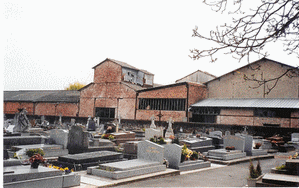
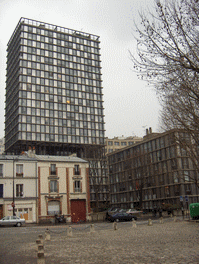

click on the images for information
on cases in France

The
ITUC has condemned the decision to exclude chrysotile
asbestos
and the pesticide endosulfan from the list of
dangerous products under the Rotterdam Convention, the
international agreement which regulates exports of
hazardous
chemicals.
A wonderful article
about the
asbestos
demonstration
this weekend in Paris and Canada's role in the French
asbestos scandal! 2008 October
Media
Release,
August 13.2008, Canada obstructing U.N. Convention
over asbestos
European Report;
April 30, 2008 -
EU/ROTTERDAM
CONVENTION :
CONTROLS TO COVER ADDITIONAL HAZARDOUS
SUBSTANCES
Another three hazardous
substances - chrysotile asbestos, endosulfan and
tributyl tin compounds - could by the end of the year
be placed under the Prior Informed Consent (PIC)
procedure applicable to international trade in certain
hazardous chemicals and pesticides. In a draft Council
decision (COM(2008)176), the European Commission
proposes to support the proposal amending to that
effect Annex III to the Rotterdam Convention(1), which
will be submitted to the Fourth Conference of Parties
(Rome, 27-31 October 2008). The Commission considers
it "necessary and advisable" to support this proposal
to ensure that countries of import benefit from the
protection afforded by the convention. It notes that
the three substances are already prohibited or
strictly regulated in the EU and subject to export
requirements that are even stricter than those set by
the convention. The Rotterdam Convention encourages
the sharing of responsibilities and cooperation
between contracting parties in the area of
international trade in certain hazardous chemical
substances. It encourages ecologically rational use of
these substances by facilitating the exchange of
information on their characteristics, establishing a
national decision-making process applicable to import
and export, and notifying these decisions to the
contracting parties. Annex III contains the list of
chemical substances covered by the PIC procedure. The
document is available at www.europolitics.info >
Search > 224620
(1) The convention was
adopted in Rotterdam, on 10 September 1998, and
entered into force on 24 February 2004. It was
ratified by the EU on 25 September 2006. Council
Decision 2006/730/EC - OJ L 299 of 28 October 2006.
BAN ASBESTOS
CANADA - MEDIA RELEASE - March 16, 2008
Ban Asbestos Canada (BAC)
applauds the NDP's support for the World Health
organization's call for action to eliminate asbestos
disease and asbestos use around the world. "This is
the first Canadian parliamentary party to take a stand
against asbestos," said Larry Stoffman, executive
member of BAC and Chair of the National Committee on
Occupational and Environmental Exposures. "Canada is
one of the few industrialized countries who have
continued to mine and export asbestos while rejecting
the call of all independent, recognized scientific
organizations around the world to ban all forms of
asbestos." BAC is a
national coalition of labour, health, and
environmental groups that are dedicated to banning
asbestos in Canada, ensuring compensation for all
affected Canadian workers, and to promoting
international conventions aimed at controlling the
international trade in hazardous substances, such as
asbestos. "We look
forward to working with the NDP to ensure both real
economic support for laid off asbestos workers and a
comprehensive campaign for just compensation for
thousands of Canadian workers afflicted with asbestos
caused disease," said Wayne Peppard, Executive
Director of the BC & Yukon Construction Building
Trades Council. "Government support for this dying
industry that has exploited Quebec workers must stop
now." "From a public
health point of view, the NDP's support for the WHO's
position is, in our view, the only possible
responsible position," stated Micheline Marier of the
Association of Asbestos Victims of Quebec. "The
population in the Asbestos region has paid a heavy
price since the beginning of mining this mineral and
we call on governments to assist in the revitalization
of the region, as well as the environmental clean-up
of the former asbestos mines" said
Marier. Increasing
numbers of Canadians are dying from asbestos, the
world's biggest occupational health killer. In 2007 in
B.C., for example, over half of occupational deaths
were from asbestos-related disease."This carnage from
asbestos related fatalities is disastrous for those
workers and their families," Peppard said. "It's long
past time that the Canadian government stop the
production and use of
asbestos". Canada
exports over 95% of its asbestos to developing
countries and has continually undermined any attempt
to have asbestos banned or labeled as a dangerous
product. "We are
calling on all the political parties to end their
unholy alliance with the asbestos industry," said
Kathleen Ruff, founder of RightOnCanada, a citizens'
human rights group. "All the political parties say
their top commitment is to protect people's health.
Let's see them put that commitment into action
and eliminate asbestos use now."
Contacts: Larry Stoffman -
604-250-3713; Wayne Peppard - 778 388-0014; Kathleen
Ruff - 250-847-1848; Micheline Marier -
514-847-8381.
Announcement
(Wednesday,
March 19, 2008; Posted: 05:02 PM).THETFORD MINES,
QUEBEC, Mar 19, 2008 (MARKET WIRE via COMTEX). Mazarin
Inc. (TSX VENTURE: MAZ.H) announces that its
wholly-owned subsidiary, 9075-6453 Quebec Inc. was
forced to assign all of its assets in the hands of
Raymond Chabot Inc., trustee. The subsidiary is the
owner of the Bell mine in Thetford Mines. Last August,
it had authorized, under certain conditions, 9184-6808
Quebec Inc. (LAB Chrysotile) to operate the mine. At
the end of this month, LAB Chrysotile will cease
operations at the Bell mine. After considering several
avenues, the subsidiary has concluded that its limited
financial resources did not allow it to operate the
mine or to meet its financial obligations on an
ongoing basis. This press release contains
forward-looking statements which reflect the Company's
current expectations regarding future events. The
forward-looking statements involve risks and
uncertainties. Actual results could differ materially
from those projected herein. The TSX Venture Exchange
does not
accept
responsibility for the adequacy or accuracy of this
release. SOURCE: Mazarin Inc. According to a press
article, it appears that law through access to
information in Canada, it was discovered in 2006 that
there is some kind of understanding between Canada and
other exporting countries asbestos (like Russia and
Kyrgyzstan), to maintain artificially high prices of
asbestos in order to prevent the bankruptcy of the
Canadian asbestos in return for funding of the
institute of chrysotile by Canada which becomes the
propagandist of asbestos in the world. But last year,
the Canadian dollar has risen considerably, thereby
increasing the cost of Canadian goods to other
countries that can no longer sustain competition. And
that is perhaps the reason, in spite of the agreement,
the bankruptcy of the mine Bell Thetfort Mines.
Media
release
dated March 11, 2008, OMG in the world, to save
the Rotterdam Convention
Endangering
others: the
appeal court of Douai just order the company Alstom,
March 6, 2008, be punished by a fine of 75,000 euros
(confirming the judgement of first instance in Lille
in 2006) for knowingly allowed the 300 employees of
the Lys-Les-Lannoy into contact with asbestos in full
knowledge of the risks from 1998 to 2001, and a former
director of the factory in 3000 euros fine and 3
months suspended prison term (instead of 9 months
sentence in the first instance, the Court having
considered that the director was merely relaying the
will of the leadership, minimizing liability). On this
last point, the employees are very unhappy because
more than 100 of them are sick from asbestos and a
dozen died. On March 14, Alstom Power Boilers
indicates that it does not provide for judicial
review.
International
Meeting in
Austria
on 6 and 7 February 2008 for a ban on asbestos in
the world.
Report
Henri
Pezerat
against Bernstein's work on chrysotile asbestos
Aulnay-Sous-Bois'
CMMP
disused
factory
A new demolition
permit and a new plan for asbestos removal must be
presented for the totallity of the site, after the
annulation, cancellation by law of those given only
for block B (old asbestos workshop).
The prefect, during
a meeting including the associations, promised that a
first flexible project, adressed to the Health, Labour
and Ecology ministries for verification, would then be
submitted, for discussion, to all protagonists,
including the associations (letter sent be the
associations on the 31/10/2007 to the
ministers).
On Saturday
25/11/2007, France3 mentionned the file on this
contaminated site (see videos on page struggle
/history and it was mentionned that the prefecture
would at last give to CMMP the order to take numerous
samples, so far this has not been done, when the
regularitions insist on this before any demolition
work is started (the associations have been asking for
this for years). On the 10/12/07 they send to the
ministries another letter which specific regards as to
technical issues. On the 25/02/2008, the associations
contacted the prefect again, because there was
absolutly no follow up to the France3 november
broadcast. Complete radio silence !
On the 29/03/2008
they wrote to the new Aulnay Sous Bois mayor to inform
him of the polluted site present situation and to ask
for his support in installing an external protection
bubble. On the 07/04/2008 they send a reminder to the
ministries (Health, Labour, Ecology), the 11/04 they
issued a press release and the 06/04 they organised a
public meeting. Around 100 people came to the
Gainville suite in Aulnay Sous Bois. The new mayor and
his environmental aide were present. Monsieur
Ségura, was in favour of "demolition in the
best conditions", then Monsieur Amédro asserted
that "the town is for demolition under external
protection airtight bubble". They promised their
support to the associations in their approach to the
authorithies and to act for the installation of urgent
measures for the safety of the locals. At the end of
the meeting, two motions were voted by the
participants to be sent to the prefect.
The new mayor wrote
to the Prefect about the emergency procedure for the
safety of the locals and issued a press release. The
associations will meet him soon. The Mayor is to meet
on site with the associations on the 3rd June. In this
way, they will be able to witness the immediate
security measures taken by the owner, before work on
the site can be started.
In the Aulnay
municipality May 2008 number, a lenghthy article tells
of the old CMMP factory site, in which it is confirmed
that the new municipality, which gives itself eighteen
months to sort everything out, is favourable to an
outside confining. We congratulate ourselves,
this will help in resolving this conflict which has
been going on for ten years.
The work inspection
of Aulnay has recently send a letter to CMMP and to
the present owner on the methodology to respect
regarding asbestos that is to say an our and
waterproof external confinment which is after all the
application of the disposition of asbestos.
As well, CRAMIF
send them the same king of letter : in this matter,
CRAMIF, with it's ingeneers and technicians, outs as
technical adviser for the work inspection, when it is
requested.
This control has
always been demanded by the prefect on the two
June.
The associations
met the prefecture represantative at the towerhall on
the nine November. Were present the mayor and his
environment deputy. They repeated their propositions
to come out of the inertia of the present situation.
Following this, on the September 17, to the prefect,
regarding the 7th prefectorial decree destined for the
CMMP (it must be remembered that after th 4th decree
of 2004, the CMMP went to law about the distribution
of cost regarding depolution and demolition, beetween
the actual owner and itself and to avoid erecting a
bubble acound the buildings and polluted grounds and
that the judge's decision was only given in July 2007
!).
During the week-end
of the 27 th and 28 th of September 2008, the
associations held a stand at the old Aulnay
association forum. An exposition on the history of the
CMMP factory pollution (development of the situation)
and a 5 mn continuons film informed the public. A
petition collected 500 signatures during that week-end
with the view of enforcing the respect of the rules
(air tight bubble) during the work of
decontamination-demolition of the old
factory.
Watch this space
....
The
Albert tower in Paris
:
In regard to the
disposal of asbestos, the foreman insisted on the
solutions recommended by CRAMIF with the endorsment by
the work Inspection Department. It brought about
further costs, but that's the price of safety. The
cheap working yards for asbestos removal, are most of
the time in breach of regulations (at the last
national control, 75 % the sites were in infraction
!). In the case of the Albert tower with its twenty
three floors and three elevators in the well an
adequate solution had to be found : one elevator cut
off, the working machinary protected by airtight
casing which will completly cut it off from the well,
stopage of the working of the elevators during the
dust removal from the well at night, the use of the
roof of the elevators as scaffolding. The three
elevators go down simultanously as the dust removal
progresses, from the top to the bottom while a strong
air current blows in the same direction to stop the
fibres going back up and thus contaminate the clean
areas. In this way, the disposing of the asbestos can
be done following regulations. The work is done in
several stages.
Today, the fourth
phase of the work has been put back several weeks,
following the breaching of a wall leading to a suspect
flocking in the car park area. Alerted by the
co-owners, Ban Asbestos send a mail on the 25/02/2008
to the work inspector supervising this site. Work
should normally start again on Monday 21/04. The
preparation of the site starting again towards the
suspect flocking, Ban Asbestos went on site to take
photos and to intervene once again with the work
inspector.
No account was
taken of our warnings and the disposal of asbestos
started again the week of the 25/04 during 5 nights
with access to the car park doubtful flocking. Now,
this time, will precautions be taken for the
dismantling of this site ? Will the suspect flocking
be at last taken away following regulations for flaky
asbestos ?
Watch this site
....
The
"Comédie Française" in Paris
:
For the second time
in a few months, the leading institution of a certain
"french culture" found itself in front of the "social
security cases court ", to answer to the accusation of
inexcusable negligence.
A first action had
been taken by the widow of F. Delayre, electrician at
the "Comédie Française". He died of a
bronco pulmonary cancer. The judgement given by the
Auxerre (TASS) had heavily sanctionned the famous
house, who since has appealed.
On the 02/02/2008,
in Nanterre, madame D. Brought a charge against this
establishment. Her husband, a machinist/stage hand,
had worked for them all his life. He died on the
27/04/2003 of a fibrosis diagnosed in 1980.
Solicitor for the
D. Family, maître Sylvie Topoaloff, presented
all the different elements of a daming case against
mister D's employer, from the medical certificate
asking the recognition of a professional illness, to
the repeated interventions by CHSCT, the CRAMIF, etc
...
"An extradocumented
file on the realisation of the danger" concluded
maître Topaloff.
In answer, the
lawyer for the Comédie Française tried
to discredit the testimonies of the file, while
trivalising the origins of the asbestos pollution of
the site and trying to present it as a succession of
airtight compartments, free of all lethal fibres. She
then produced her joker : the certificate of an
"independant" (sic) doctor, who reinterpreted without
the permission of the family and in violation of
professional ethic, the medical file of Mr D. Among
this interpretation, one must note "hypersensibility
to birds" because Mr D. Kept a canary. Nobody knew,
until now, that feathers could cause pulmonary
fibrosis.
Judgement was
given. It did not condemn the Comédie
Française for gross negligence and dismissed
all the widow's demands. It provoked utter
consternation and great anger within the victim's
family and quite rightly because the case against the
Comedie was overwhelming. Monsieur D'family has
decided to appeal. The complete file will be
transfered to the Versailles Appeal Court.
The second
proceeding against the Comedie Française
(Monsieur Delayre) must take place on June 12 to
Appeal Court.
Watch this site
......